
Chess classes for kids, built around how children actually learn
Four age tracks, because a six-year-old and a fifteen-year-old need completely different coaching. In HSR Layout, and live online.
- Batches of 6
- FIDE-rated coaches
- Monthly written reports
A chess class should change how a child handles being wrong.
The same method. Four completely different classrooms.
What changes between tracks is not the difficulty of the puzzles. It is the length of the session, the amount of physical movement, how much is explained versus discovered, and what a coach does when a child gets something wrong.
First Moves
Twenty minutes of real attention, and the courage to touch a piece. Shorter sessions, more movement, and no expectation that a four-year-old sits like a twelve-year-old.
Ask about this track →Little Thinkers
Patterns become automatic and losing stops being a catastrophe. This is the age where deliberate tactical practice starts paying compound interest.
See this track →Strategic Minds
Calculation, candidate moves, and the clock. The years when playing a lot stops being enough and thinking properly starts to matter.
See this track →Young Masters
Preparation, rating, and self-management. Opening files, tournament routines, and how to lose a game in round two and still play well in round three.
Ask about this track →Six things, described honestly
You will not find a claim about IQ, school marks or attention disorders anywhere on this website. Here is what chess does do, stated at the size it actually is.
- 01 Attention span, at the boardA child who could sit for ten minutes can usually sit for thirty within a term. Whether that transfers to homework is not something we can promise, and we will not.
- 02 Patience with their own mistakesChess produces an error you cannot blame on anyone else roughly every four minutes. That is uncomfortable, and it is the entire value of the game.
- 03 Calculating before actingThe habit of asking “and then what?” before committing. This is the single skill we spend the most class time on, at every age.
- 04 Sitting with an uncomfortable positionBeing worse and still playing well is a specific, learnable skill. Most children resign internally long before they resign on the board.
- 05 Accepting feedback without collapsingAnalysis is a routine here, not a correction. A game is reviewed the same way whether it was won or lost.
- 06 Recovering mid-gameWhat happens in the three moves after a blunder decides more junior games than the blunder itself.
Your move.
A position at roughly the level of our Little Thinkers batch. Black to move — and from b4 the knight is touching nothing at all. It can reach six squares. From one of them it attacks two white pieces at once; from two others it attacks exactly one; from the remaining three, nothing. Have a look before you read on, and let your child try it too.
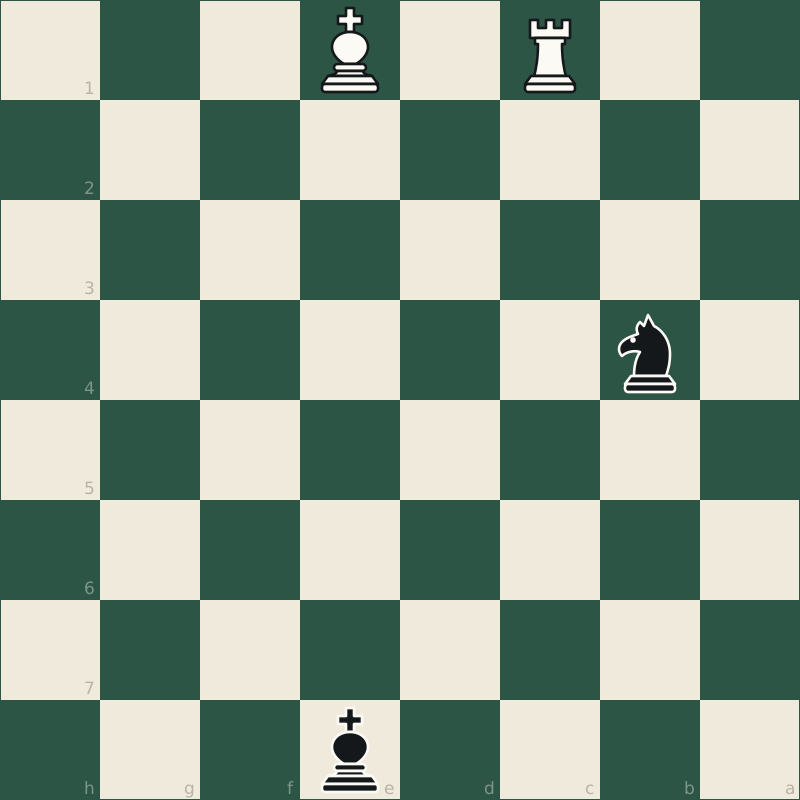
The question is always the same one. What does this piece touch from here? Ask it of a2, of c2, of d3, of d5, of c6 and of a6, one square at a time, and the answer arrives on its own. There is nothing to calculate and nothing to memorise.
It matters that two of those squares give check and only one of them does anything else. A check that wins nothing is still just a check — and White gets a free move to reply to it.
Six-year-olds find this faster than adults do, because they look at the board rather than at what they already know about knights.
In a class we would not put the answer on the board. We would ask what the knight touches from each square, and wait.
The same six-step loop, at every age
Learn a pattern. Practise it deliberately. Play real games. Analyse them by hand before an engine is opened. Improve one specific thing. Reapply it in the next game — and check whether it held.
You will actually know what happened.
Every month you receive a written report covering four columns: chess development, thinking development, learning behaviour, and competition readiness. It names specific positions from specific games.
It is not a rating number and a thumbs-up, and it is not a WhatsApp message saying “doing well”. It is the document you would want if you were paying for coaching in anything else.
Find out where your child actually is, before you choose a track.
The report recommends a track, and tells you why
Questions parents ask about children’s chess
What is the best age to start chess?
Four, if the child can sit for about twenty minutes. But there is no window that closes. A child who starts at ten is not behind — they will simply move through the early levels faster than a five-year-old does, because the abstraction is easier for them.
My child has never played. Will they be lost?
No. The first level assumes nothing at all, including the names of the pieces. Every batch is grouped by level as well as age, so a beginner is never sitting opposite someone who has been playing for three years.
Will they lose interest after a few months?
Some children do, and we would rather say so than promise otherwise. The two things that hold interest are playing real games early and having a coach who explains why a move failed rather than just correcting it. Both are built into the session shape from the first class.
How many classes a week?
Two. Chess improvement comes from what happens between the classes — the practice set, the games played, the mistakes reviewed — and two sessions a week leaves room for that. More classes is the most common thing parents ask for and the least likely thing to help.
Online or in person for a young child?
For 4–6, in person if it is practical: a young beginner benefits from a coach who can physically reset a board and hold attention in the room. From about seven upwards, online works as well as offline provided the batch is genuinely small and the child has a real board beside the screen.
What if my child cries after losing?
That is common, it is not a character flaw, and it is trainable. We teach a fixed post-mistake routine rather than telling a child to cheer up, and we treat the three moves after an error as the part of the game that matters most. There is a full article on this, and a section of the method devoted to it.
Do you push children into tournaments?
No. Tournaments are offered, prepared for properly, and never required. A child who is pushed into a rated event before they are ready usually learns that chess is frightening — which is the opposite of the thing we are trying to build.
Choosing chess classes for your child
Most parents come to chess for one of three reasons: the child asked, the school ran a session and something clicked, or the phone has become a problem and chess looks like a better place to put an hour. All three are good reasons. What follows is what actually matters once you start looking at academies, written by people who would rather you chose well than chose us.
What age should a child start chess?
Four is realistic if the child can sit for about twenty minutes and is not frustrated by rules. Between six and nine is the easiest starting window: the pieces make sense quickly, patterns stick, and children of that age will happily play the same kind of position twenty times, which is exactly what tactical training requires. Ten and above is not late. An older beginner covers the first two levels considerably faster because the abstraction is no longer the hard part.
The mistake worth avoiding is starting a four-year-old in a class designed for eight-year-olds. It is the most common reason a young child decides they do not like chess, and the damage takes a year to undo.
How often should a child play?
Two classes a week, and something small on most other days. Fifteen minutes of tactics beats a two-hour session at the weekend, because pattern recognition is built by frequency rather than duration. Playing games matters too, but games alone are the most common reason a child plateaus: they reinforce whatever the child already does, including the bad habits.
A workable week for a seven-year-old is two classes, fifteen minutes of puzzles on four days, and two or three real games with a person rather than a phone. For a twelve-year-old the puzzle time goes up and the games get longer, with the clock on.
What progress actually looks like in the first six months
Months one and two look like almost nothing. Your child learns the pieces, the basic mates and the first tactical patterns, and loses most of their games. This is the stage at which parents most often worry, and it is entirely normal.
By month three you should start to see the specific change worth paying for: your child pauses before moving. Not always, and not for long. But the instant-move habit begins to break, and they start noticing what the opponent is threatening before they think about their own plan.
By month six a child who has practised will stop hanging pieces in simple positions, will recognise forks and back-rank patterns without calculating them, and — the part we care about most — will be able to tell you where the game went wrong afterwards. Ratings and trophies, if they come at all, come later than that. Any academy promising a rating inside six months is selling you something they cannot deliver.
If you would rather see this than read about it, book a free demo class or walk into the HSR Layout centre during class hours. If you want to know where your child stands first, the free chess report card takes eight minutes.
Where to go next
Start with a diagnosis, not a sales call.
Eight minutes, on a phone, and you will know which of the four tracks your child belongs in and what to train first.