
Every game is three minutes long
Blitz rewards the moves that already come naturally. A child who only plays fast is practising their current habits several hundred times a week.
The years chess gets serious — calculation, plans, and playing under a clock. In HSR Layout, and live online.
“He plays all the time and he’s stopped getting better.” That is a diagnosis, not a mystery.
Blitz rewards the moves that already come naturally. A child who only plays fast is practising their current habits several hundred times a week.
Without analysis, a loss teaches nothing except that losing is unpleasant. The same mistake is then repeated for months in slightly different positions.
If a fork still has to be worked out, calculation is being spent on finding it. There is nothing left over for the actual decision.
A Strategic Minds position. White to move, two rooks on open files, and a black king that has never made itself an escape square. The point at this level is not whether you find the move — it is whether you looked at the back rank before you looked at anything else.
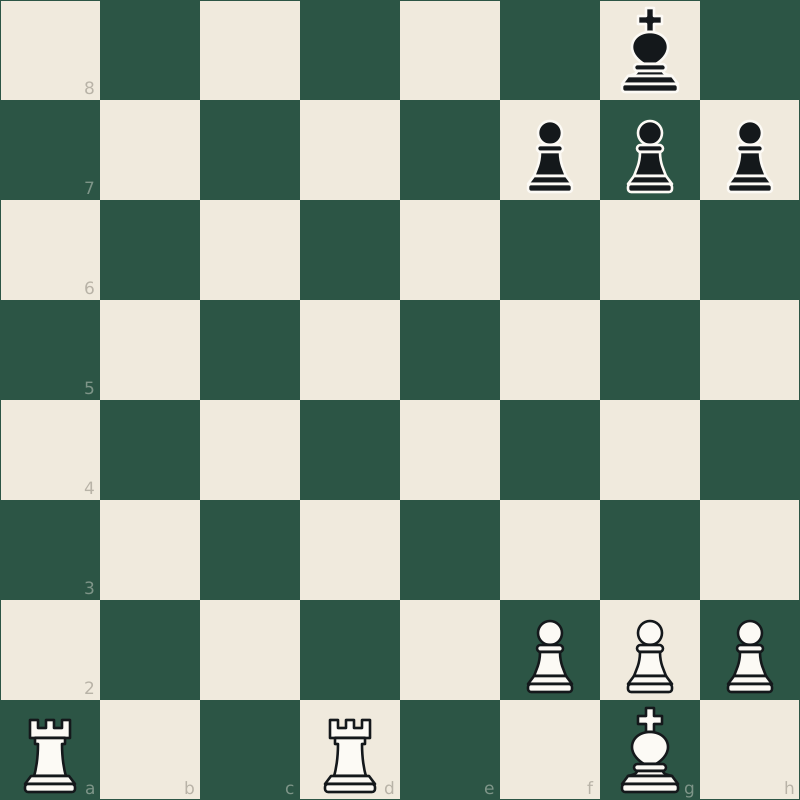
The king on g8 is boxed in by its own pawns on f7, g7 and h7. A rook arriving on the eighth rank is mate on the spot, and it does not matter which one goes: Ra8 and Rd8 are both mate in one.
This is why we teach the scan before the plan. Rd7 — the seventh rank, the move that looks strongest — is still winning. It also lets Black play h6, and a mate in one becomes a long technical grind. When there is something concrete on the board, a general principle is the wrong tool for the moment.
Comparing two candidate moves before playing either one is the single habit that separates this age group from the one below it.
| Block | Time | What happens |
|---|---|---|
| Teach | 30 min | One idea, usually taken from a game somebody in the batch actually played that week. |
| Play with clocks | 40 min | Real games at a real time control, with scoresheets. |
| Analysis | 20 min | By hand, out loud, before any engine is opened. What was thought, and what was true. |
Human analysis before engine analysis is pillar six of our method. The engine confirms; it does not teach.
That is the change. It is small, it is unglamorous, and it is the thing that moves a rating for the next four years. A child who compares candidate moves at twelve does not stop doing it at sixteen.
What you will notice at home is different: they start talking about a game after it ends, including the ones they lost.
Find out exactly which of the three plateau reasons applies to your child.
The report names one thing to work on — not five
Almost always one of three things: every game is played at three minutes, no game is ever analysed, or the tactical patterns were never made automatic and calculation is being spent on finding them. The report card at the end of the free test names which of the three it is.
No. An eleven-year-old beginner covers the first two levels faster than a six-year-old does, because the abstraction is easy for them. What they miss is the years of pattern reps, and that is caught up with deliberate practice rather than with time.
When he wants to and has been prepared for it. A rated event before the preparation is in place teaches a child that chess is frightening. We prepare specifically: openings he actually understands, a clock routine, and a plan for what to do after a loss in round two.
No. At this level, memorised lines produce a child who is fine for eight moves and lost on move nine. We teach opening ideas — what the position wants — and the memorisation comes later, if it comes at all.
By treating it as a real risk rather than a lack of commitment. Two classes a week, capped practice, no tournament calendar we did not agree with the child, and permission to take a month off without losing their place in the batch.
Not first. Human analysis before engine analysis is one of the nine pillars of the method: the child writes down what they thought, we go through it by hand, and only then do we check with an engine. An engine that gives the answer before the thinking has happened teaches nothing.
If he plays rated tournaments, yes — that is arithmetic, not coaching. What number it settles at is not something anyone can promise you, and we will not. We have never published a rating guarantee and we will not start.
This is the age band where chess either becomes serious or quietly fades out. Children arrive at ten with two or three years of play behind them, a rating somewhere between 600 and 1200 online, and a growing sense that they are no longer getting better. Most of them are right about that, and the reason is almost never talent.
Up to about nine, chess improvement is mostly pattern storage: see enough forks and you find forks. From ten onwards, that stops being enough. The positions that decide games are ones where nothing is hanging, no tactic exists, and the correct move is only correct three moves later. Getting better at those positions requires calculation — and calculation is a trainable, teachable process, not a talent that some children have.
The process we teach is deliberately plain. Name two or three candidate moves. For each, name the opponent’s best reply. Evaluate the resulting position in words. Choose. Most children of this age can do all four steps when asked and none of them when not asked, which is what the class time is for.
A child who has only played online blitz has never had to decide how much time a decision deserves, because in three minutes every decision gets the same three seconds. Introducing a proper time control usually produces two weeks of much worse chess followed by a visible jump. It is the closest thing to a reliable step change we see at this level.
We also teach the specific mechanics — writing down moves, checking the clock at fixed intervals, and what to do when you have five minutes for fifteen moves. These sound like administration and they win games.
A FIDE rating is arithmetic: play rated events and you will have one. What it settles at depends on the child, the preparation and several years, and anyone who quotes you a number is inventing it. What we can be specific about is the preparation — openings the child genuinely understands, a routine for the hour before a game, and a plan for what happens after a loss in round two, which is the round that decides most junior tournaments.
Tournament anxiety at this age is common and it responds well to being treated as a normal, expected part of competing rather than as a problem with the child. We handle it as a training topic, not a personality one.
If your child has plateaued and you want to know precisely where, the free chess report card measures tactics, calculation, board vision and endgame separately and names the weakest of the four. The full method is published if you would rather read it first, and the HSR Layout centre takes walk-ins during class hours.
Eight positions and three questions produce a report that names the specific gap — and the eight weeks of training that would close it.
Find out exactly where your child stands across five chess skills — and the one thing worth training next. Free, no account, no sales call unless you ask.