

[CONFIRM: real parent testimonial — quote, first name, child’s age, online or HSR Layout]
Placeholder testimonials are an E-E-A-T risk and a trust risk. This card ships empty on purpose.
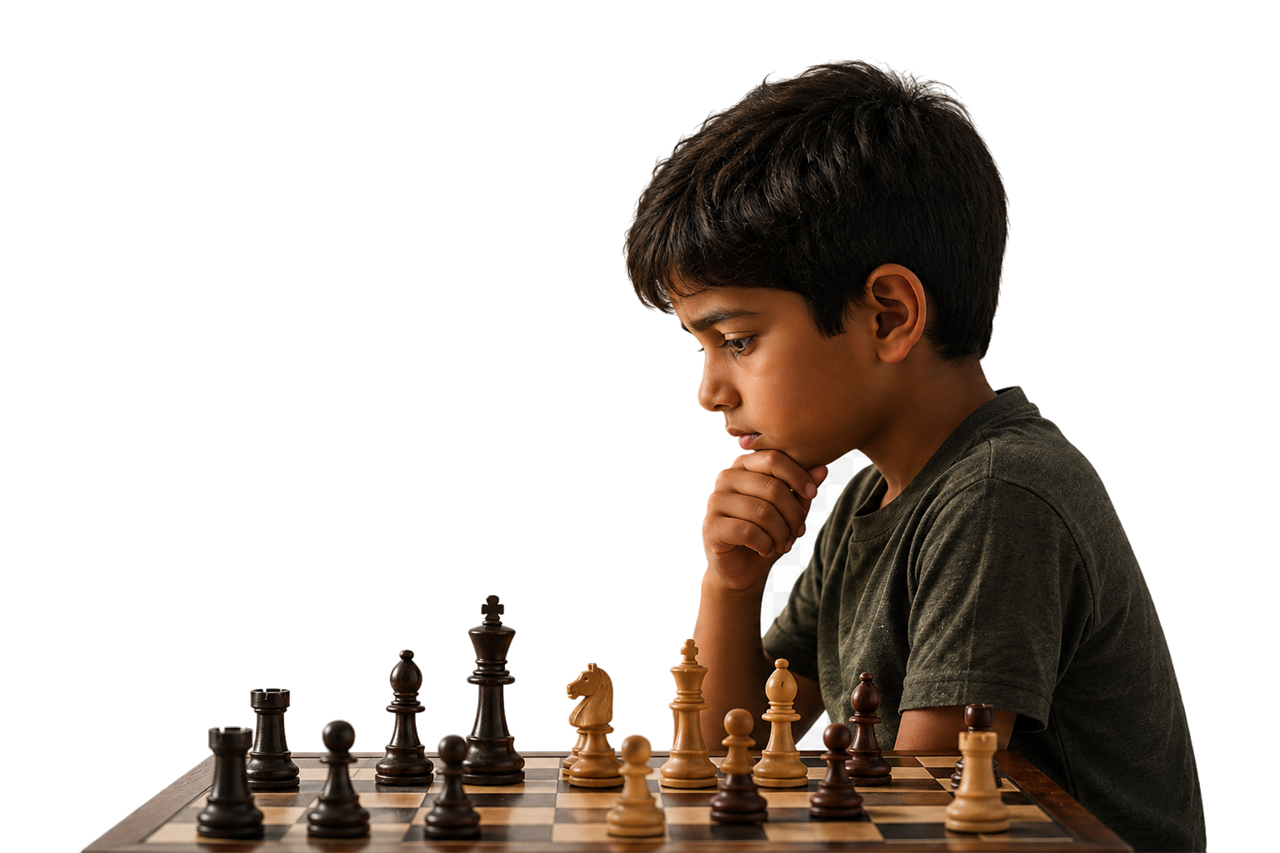
Most academies tell you your child won. We tell you how your child thought.
Every claim below links to the page that proves it. None of them requires you to take our word for anything.
The curriculum is built around how a child's attention, memory and frustration actually develop — not around an adult syllabus made smaller.
The founder’s storyEvery coach has a public FIDE profile. You can look them up before you enrol — the links are on the coaches page.
Meet the coachesOur full method and level-by-level curriculum are published on this site. Read them before you decide anything.
Read the methodBlack has just played …Ng4. Two black pieces now bear down on f2 — the knight from g4 and the bishop from c5 — and exactly two white pieces defend it: the rook on f1 and the king on g1. This is the position we put in front of a new student, because the first useful question here is not “what can I attack?” but “what is he threatening?”
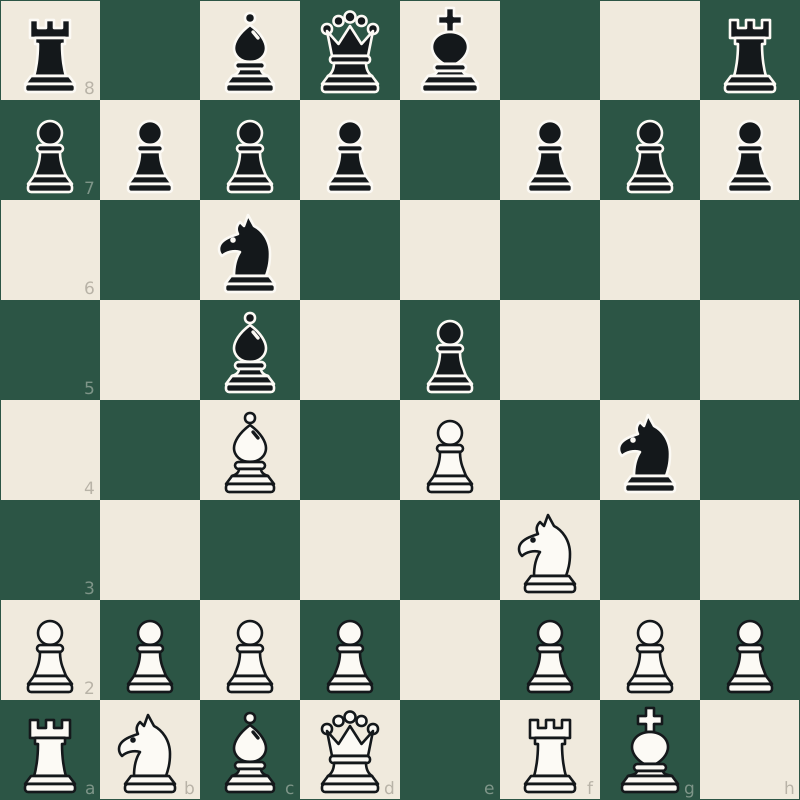
Count before you calculate.
Two attackers, two defenders — so f2 holds, and it stops holding the moment one of those defenders walks away. That is the entire lesson, and it is why the rook on f1 is doing far more work than it appears to be doing.
Every move a strong engine likes here — c3, d3, Nc3, h3 — leaves that rook exactly where it stands. Play it to e1 instead and Black answers Nxf2, forking the queen on d1 and the pawn on e4, and the evaluation swings by about three pawns. One square, and the position changes hands.
A child who has learned to ask what is attacked, and by how many, sees that before they see anything else. That is a habit, not a talent, and it is the first thing we train.
This is exactly how we teach: the position first, the question second, and the answer last. There is no score here and nobody says “wrong”.
A child gets stronger when they learn to see, calculate, decide, reflect, correct, and try again. Not by attending more classes. Every level, every age group and every format at 64Moves runs on the same six-step loop.
Four child tracks and an adult track. A six-year-old and a fifteen-year-old need genuinely different coaching, so they get it.
| Track | Ages | From |
|---|---|---|
| First MovesThe board, the pieces, and sitting still | 4–6 | ₹3,000/mo |
| Little ThinkersPatterns, tactics, and losing without collapsing | 6–9 | ₹3,500/mo |
| Strategic MindsCalculation, plans, and the clock | 10–13 | ₹4,000/mo |
| Young MastersRating, preparation, and self-mastery | 14–18 | ₹4,500/mo |
| AdultsBeginners and stuck-at-1200 players | 18+ | [CONFIRM: adult pricing] |
Offline fees are per month, two sessions a week, batch of six. Online and one-to-one pricing: [CONFIRM: online group and one-to-one pricing]. Everything we charge is on the fees page.
Eight minutes. One honest report. No sales call unless you ask for one.
Works on a phone · Ages 6+ · Adults too · The report appears instantly
[CONFIRM: founder’s name, qualification, university, years of practice, and two sentences in her own voice]
This block stays visibly incomplete until the real credentials are supplied. An education site that names an unverifiable expert is worse than one that names nobody.
Three real quotes belong here — first name, child’s age, and format. We will not write them for you, and we will not run a placeholder quote in their place.
[CONFIRM: real parent testimonial — quote, first name, child’s age, online or HSR Layout]
Placeholder testimonials are an E-E-A-T risk and a trust risk. This card ships empty on purpose.
[CONFIRM: real parent testimonial — quote, first name, child’s age, online or HSR Layout]
Placeholder testimonials are an E-E-A-T risk and a trust risk. This card ships empty on purpose.
[CONFIRM: real parent testimonial — quote, first name, child’s age, online or HSR Layout]
Placeholder testimonials are an E-E-A-T risk and a trust risk. This card ships empty on purpose.
If yours is not here, message us on WhatsApp — a coach answers, not a bot.
No. Most of our students start at zero. The first level assumes nothing — not the names of the pieces, not how they move.
Four, if they can sit for twenty minutes. We run a separate track for 4–6 year-olds for exactly this reason: the class is shorter, more physical, and built around attention rather than syllabus.
Same coaches, same curriculum, same batch size. Online adds recorded analysis; offline adds face-to-face board time. Neither is a compromise, and you can switch between them.
Six students. That is a cap, not an average. If a batch is full, you wait for the next one — we do not add a seventh chair.
A written monthly report covering tactical recognition, calculation, decision-making and how your child responds to mistakes — not just a rating number.
L63, 1st Floor, 15th Cross, Sector 6, HSR Layout, Bengaluru 560102. Walk in during class hours and watch a session from the back of the room. You do not need to book anything to do that.
64Moves is a chess academy on 15th Cross, Sector 6, HSR Layout, Bengaluru. Families come to the centre from across HSR Layout and from Koramangala, BTM Layout, Bellandur, Sarjapur Road, Agara and Somasundarapalya — most of them a ten to fifteen minute drive away. Everything taught in that room is also taught live online, to the same curriculum, by the same coaches, to families across India and in Gulf, UK and US time zones.
The classes suit children from four years old through to eighteen, and adults who are either starting from nothing or stuck at a rating they cannot move past. A complete beginner and a rated tournament player are not put in the same batch, and neither is a six-year-old and a twelve-year-old: there are four separate children’s tracks and an adult track, and each has its own syllabus, session shape and pace.
Three things, and all three are checkable rather than claimed. The academy was founded by a child psychologist, so the curriculum is sequenced around how attention, working memory and frustration tolerance actually develop rather than around an adult syllabus made smaller. The coaches are FIDE-rated with public profiles you can look up. And the full method — all nine training pillars and the level-by-level curriculum — is published on this website, before you pay anything.
Batches are capped at six students. That is the number at which a coach can still watch every board, interrupt the right child at the right moment, and write a monthly report that says something specific. Above six, group chess coaching quietly becomes a lecture with boards in the room.
Week one is assessment: the coach watches how your child decides a move, not just whether the move was good. Weeks two and three introduce the level’s core patterns and the deliberate practice routine that goes with them. By week four your child has played rated practice games inside the batch and has had at least two of their own games analysed out loud, by hand, before any engine is opened. At the end of the month you receive a written report covering tactical recognition, calculation, decision-making and response to mistakes.
You can apply all five of those criteria to us. That is the point of publishing them. If you want to see the room before deciding anything, walk in during class hours and sit at the back — or start with the free chess report card and find out where your child actually stands first.
Eight minutes on a phone tells you more about where your child stands than a demo class does — and it costs you nothing, including a phone call you did not ask for.
Or message us on WhatsApp · +91 82174 25648
Find out exactly where your child stands across five chess skills — and the one thing worth training next. Free, no account, no sales call unless you ask.